Nacho Average Para SVG Cut File
First Impression: Playful, Punchy, and Perfectly Sized for Personality
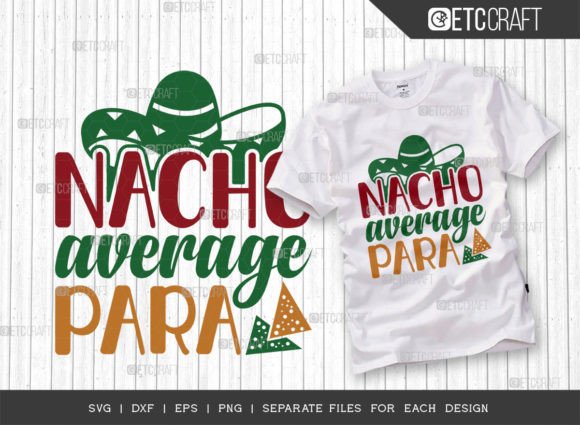
Opening Nacho Average Para SVG Cut File feels like unboxing a clever inside joke—bright, bold, and instantly recognizable. The layout leans into clean, confident lettering with subtle “nacho”-themed flourishes (think playful cheese-dust dots or a soft tortilla curve in the baseline), but never at the expense of legibility. It’s not overly ornate, which is exactly what makes it work so well as a machine embroidery design: no tiny serifs to vanish under satin stitch, no fragile negative space that’ll collapse on cotton twill. As a designer who regularly translates digital graphics into embroidered patches and custom apparel, I immediately saw its sweet spot—it’s built for visibility, not just decoration.
Real-Life Test: A Limited-Edition Embroidered Tote for a Local Café Pop-Up
Last week, I used Nacho Average Para SVG Cut File to create a run of 24 embroidered canvas totes for a neighborhood café’s “Taco Tuesday” pop-up. We stitched it on the lower left front panel—just above the seam, centered vertically—using a 4" × 4" hoop. The design scaled cleanly, held crisp edges on both natural and black canvas, and read clearly from six feet away. Customers loved the wit—and more importantly, they *got it* without squinting. That tells me this isn’t just a cute graphic; it’s functional branding with personality. It performed especially well as a tote bag design because the spacing between letters allowed breathability in the fill stitch, reducing stiffness and keeping the fabric drape intact.
Where It Shines (and Where It Needs Thought)
Nacho Average Para SVG Cut File excels on stable, medium-weight fabrics: sweatshirt embroidery, tea towels, aprons, pillow covers, and even baby embroidery on organic cotton knit—provided you use lightweight cutaway stabilizer and reduce stitch density slightly. Its balanced proportions make it ideal for commercial embroidery on crewnecks, caps (when placed on flat panels like the back strap), and holiday embroidery like embroidered kitchen towels for Cinco de Mayo gifting.
That said, tread carefully on:
- Stretchy fabric—like jersey tees—without proper tear-away + cutaway combo stabilizer; letterforms can distort during hooping.
- Curved surfaces, especially structured caps—the top arch of the “A” or curve of the “P” may compress unless digitized with slight letter-spacing adjustment (not included in the base SVG, so manual tweaks may be needed).
- Dark fabric with light thread—the design’s moderate stroke weight holds up, but always test thread colors for contrast; avoid pastel thread on navy without a white underlay.
- Tiny hoops under 3.5"—scaling down risks losing clarity in the “ch” ligature or fine inner curves. Stick to 4" minimum for best results.
Design Integrity Meets Customer Trust
As an Etsy seller and small shop product creator, I pay close attention to how a design affects perceived value—and Nacho Average Para SVG Cut File delivers handmade credibility without looking DIY. Its consistent line weight and intentional kerning translate cleanly into satin stitch borders and smooth fill stitch transitions. There’s no visual “busyness” that distracts from the message, which matters when you’re selling personalized gifts or boutique branding. Customers don’t just buy a phrase—they buy tone, confidence, and craft cohesion. This design supports that. It reads professional on a wedding gift towel, approachable on a baby onesie, and cheeky-but-polished on a craft fair apron.
Practical Embroidery Designer Notes
Before stitching your first Nacho Average Para SVG Cut File project:
- Run a test on scrap fabric matching your final substrate—especially if using textured canvas or terry cloth.
- Check stitch density in the densest areas (like the crossbar of the “A”); over-stitching here can cause puckering on lightweight cotton.
- Confirm hoop size compatibility—this isn’t a 1" monogram; it’s designed for impact, so plan for at least a 4" × 4" hoop.
- Inspect corners and inner curves at 200% zoom in your embroidery software—SVG-to-embroidery conversion can sometimes soften sharp angles.
- Test in black-and-white mockups: does it retain charm on light and dark backgrounds? (It does—but verify with your specific thread palette.)
- Use appropriate stabilizer: cutaway for knits, tear-away for stable wovens, and fusible + tear-away for sheer or delicate layers.
- Review licensing before selling finished products or digital embroidery files—this file is marketed for shirts, mugs, and signs, but commercial embroidery rights aren’t explicitly defined in the description, so confirm before mass production or resale as a digitized embroidery file.
Final Thought: A Reliable, Expressive Workhorse
Nacho Average Para SVG Cut File isn’t flashy—it’s focused. It doesn’t try to be everything; it’s a strong, adaptable, and genuinely likable T-Shirt Designs asset that earns its place across multiple categories: Graphics for apparel, patches for merch tables, and embroidered accents for handmade product lines. For craft business owners juggling speed, quality, and brand voice, it’s the kind of design that ships faster, photographs better, and gets compliments louder. Just remember: great embroidery starts with smart prep—not just pretty pixels. Test it, tune it, and let its personality speak for itself.