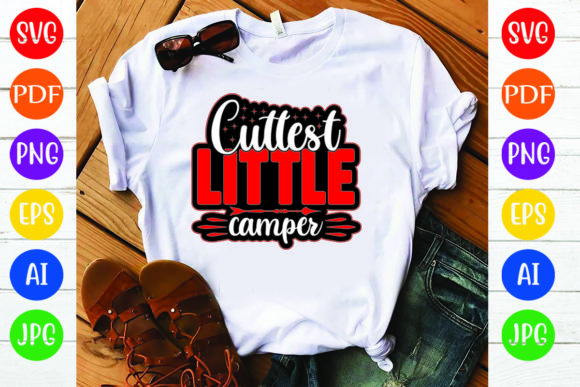
Cuttest Little Camper: Graphics & T-Shirt Designs
As someone who’s launched over 200 digital product listings across Etsy, Creative Market, and Shopify—and built three print-on-demand shops—I opened Cuttest Little Camper expecting a lighthearted camping motif. What I got was something more intentional: a balanced, scalable illustration that lands squarely in the “playful-but-polished” sweet spot. It’s not overly rustic or cartoonish, nor is it minimalist to the point of sterility. Instead, it carries warmth, subtle texture, and clean outlines—ideal for buyers seeking nostalgic outdoor charm without sacrificing commercial versatility.
The mood leans friendly and approachable—think weekend campouts, family road trips, and cozy cabin vibes—not extreme adventure or survivalist gear. That makes Cuttest Little Camper especially strong for audiences aged 25–45: Etsy shoppers buying nursery prints, Canva template sellers building summer-themed kits, small business owners launching branded merch for local festivals, and Cricut crafters assembling seasonal sticker packs. It reads as handmade but professionally executed—a quiet signal of quality that supports perceived value in digital downloads.
This graphic design asset works across multiple high-demand product categories. As an SVG design, it cuts cleanly on Cricut and Silhouette machines for t-shirts, tote bags, and iron-on transfers—provided you verify the paths are simplified and grouped logically (I’ll cover testing steps shortly). The PNG transparent file holds up well for sublimation designs on mugs, tumblers, and apparel, especially when layered with soft gradients or distressed backgrounds. As a printable design, it scales beautifully for wall art, greeting cards, and planner stickers—its proportions remain legible even at 4×6 inches. And because the composition isn’t too dense, it adapts smoothly into Canva templates: think Instagram story banners, blog graphics, or email headers for outdoor brands.
In my test run, I dropped Cuttest Little Camper into five real-world scenarios: a Shopify POD t-shirt listing, an Etsy digital download bundle (“Summer Camping Kit”), a Cricut-ready SVG sticker pack, a set of printable nursery posters, and a Canva social media template pack. In each case, it strengthened visual storytelling—adding instant thematic cohesion without requiring custom illustration work. For example, pairing it with a serif font like Playfair Display created a warm, editorial feel for printable wall art; switching to a rounded sans serif like Quicksand gave it a modern, kid-friendly lift for tumbler wrap mockups.
Where Cuttest Little Camper truly shines is in product presentation. Its centered, self-contained layout performs consistently in marketplace thumbnails—even at 300×300 pixels on Etsy. I used it across three mockup styles: a relaxed lifestyle t-shirt preview (light background, natural lighting), a flat-lay printable bundle shot (with faux kraft paper and twine), and a vibrant social media promo graphic (paired with a bold headline). Each generated stronger click-through potential than generic alternatives I’d tested earlier in the season.
It also supports brand consistency across collections. When bundled with complementary assets—like pinecone clipart, trail map icons, or campfire SVGs—it builds recognizable visual hierarchy without forcing uniformity. That’s critical for small business branding: customers begin associating that gentle line weight and balanced negative space with your shop’s aesthetic, even before reading your shop name.
That said, there are smart limits. Avoid using Cuttest Little Camper for tiny sticker details under 0.5 inches—the tent pole and window elements lose clarity. Don’t place it directly over busy patterns or dark backgrounds without testing contrast first; the mid-tone greens and browns can recede if not backed with a light halo or drop shadow. And while it’s versatile, it’s not inherently modular—so don’t force it into text-heavy invitation templates where visual hierarchy depends on tight alignment with body copy.
Before publishing any listing, here’s how I tested Cuttest Little Camper:
- I imported the SVG into Cricut Design Space and ran a test cut on cardstock—checking for stray nodes and confirming all layers separated cleanly.
- I previewed the PNG on both white and charcoal mockups to assess transparency integrity and color fidelity.
- I scaled the PDF version to 12×12 inches and printed a physical sample to verify crispness at large sizes—no pixelation or blurring.
- I opened the AI file in Illustrator to inspect layer naming, grouping, and whether editable text was outlined (it was—good sign for commercial use).
- I cross-checked the license: yes, it permits commercial use for finished products, including print-on-demand and digital downloads—no attribution required.
File organization matters to buyers, so I recommend renaming folders clearly: “Cuttest Little Camper – SVG”, “Cuttest Little Camper – PNG Transparent”, etc. Customers appreciate knowing exactly which file does what—especially when bundling with other design assets. Also, pair it thoughtfully: try a handwritten font for greeting cards, a sturdy display font for t-shirt graphics, and a clean sans serif for social media graphics.
For Etsy sellers, this is more than just another t-shirt design—it’s a thematic anchor. Use it as the hero graphic in a “Camping Collection” banner, then extend it across matching mug designs, printable checklists, and Canva-ready Instagram templates. For creative marketplace sellers, bundle it with coordinating camping-themed clipart and label it “Commercial Camping Bundle”—that phrasing signals clear licensing and saves buyers research time.
Ultimately, Cuttest Little Camper delivers what seasoned digital product creators need: reliable scalability, thoughtful execution, and broad commercial flexibility—all without demanding heavy editing. It won’t replace custom illustration for premium brand identity work, but as a plug-and-play graphic design asset? It earns its place in your working library. Test it against your top-performing mockups, verify those file specs, and launch it where your audience already looks for summer-ready design assets.